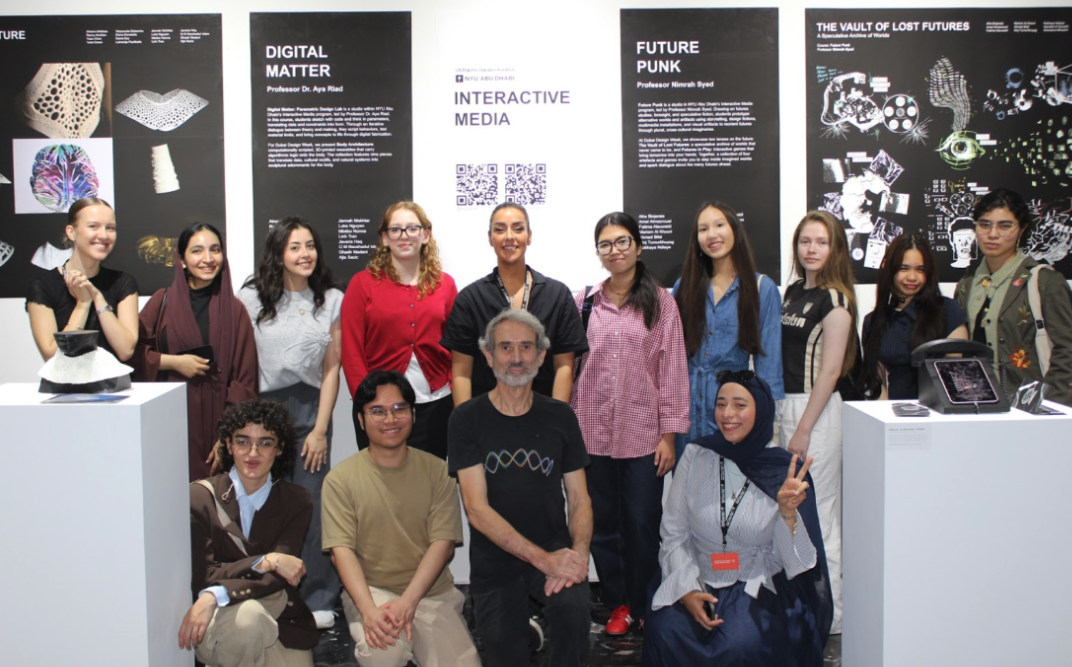
NYUAD at Dubai Design Week 2025

During the first week of November, the NYUAD Interactive Media program participated in the annual Dubai Design Week, the largest creative festival in the Middle East. Students from Spring’25 classes Digital Matter: Parametric Design Lab, taught by Professor Aya Riad, and Future Punk, taught by Professor Nimrah Syed, exhibited their works at the NYUAD Pavilion, welcoming hundreds of visitors throughout the week. The range of topics addressed by projects on display was vast – from an experimental app that allows people to explore their alternative futures to 3D-printed parametric representation of the brain outside the human body. Students’ creations inspired viewers to think critically about our shared present and speculative future in the realm of design and technology, presenting a thought-provoking interpretation of current trends and approaches.
Exhibition of works at a design festival of this scale could not pass by without new creative connections and collaborations. Design Vihara Atelier, AVO Architects, Ozora Design Hub, and Navex Design Studio – major architecture studios based in India – not only presented their own installations at the Design District, but also filmed a reel about the NYUAD Pavillion projects. Highlighting students’ artistic achievements in such a creative format, they brought attention to the Interactive Media program from other countries around the world. Furthermore, depth and quality of the exhibited projects was highlighted by Mert Sezer, founder of an international consulting agency Formeta Design. In his Instagram post Mert Sezer shared congratulations on the incredible achievement of the Interactive Media team, adding that “seeing such forward-thinking, experimental work coming directly from a university environment is truly inspiring.”
In total 12 projects by Interactive Media students were presented at the festival.

Digital Matter:
Cradle by Jannah Mokhtar
This 3D-printed jewelry set composed of a bangle and a ring, is inspired by the subtle complexity of natural forms like shells, coral, and coastal textures. Reflecting the balance between protection and delicacy, the pieces are designed to flow with the body’s natural contours – wrapping around the wrist and fingers with asymmetrical, organic forms that merge ornament with anatomy while ensuring comfort and wearability.
Dragonshell by Linh Tran and Luke Nguyen
The mystical creature, the dragon, appears in folk tales across many cultures. Dragonshell uses parametric design and 3D printing techniques to recreate the form and pattern of an eastern dragon’s body, transforming its scale structure into a continuous, fluid piece that wraps around the neck. It symbolizes protection and freedom of movement, reflecting the dragon’s enduring role as a powerful and graceful being.
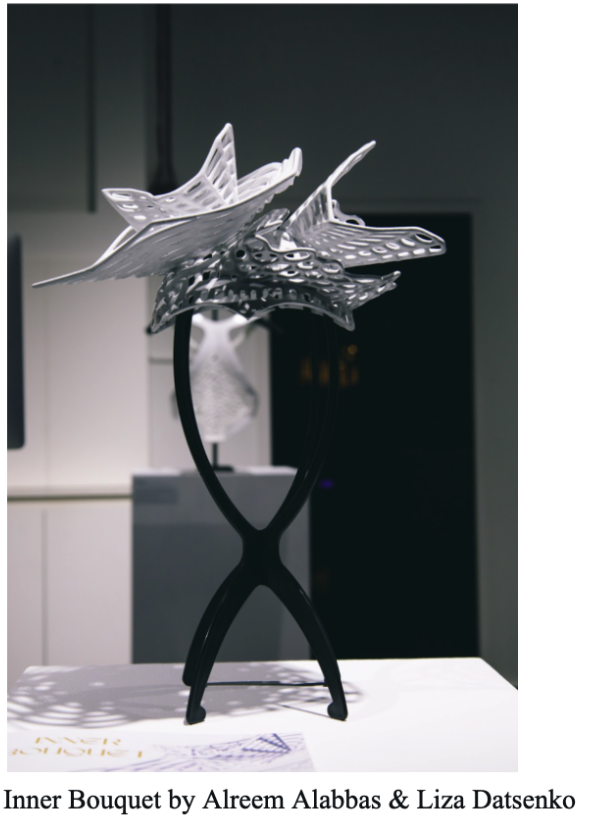
Inner Bouquet by Alreem Alabbas and Liza Datsenko
This 3D-printed parametric veil hat transforms invisible emotions into a tangible, wearable form – revealing what is felt but never spoken. Inspired by Ukrainian TV host Kateryna Osadcha’s signature avant-garde headwear, the piece merges expressive design with digital fabrication to embody individuality and emotional transparency.
Isohypsophilia by Dania Ezz and Ajla Sacic
Isohypsophilia is a 3D-printed bracelet that transforms elevation data into a tactile, wearable landscape, reinterpreting contour lines as continuous, borderless forms. Designed through parametric modeling and fabricated in flexible TPU, it turns real or imagined terrains into personal geographies – merging earth, memory, and algorithm into an intimate expression of place.
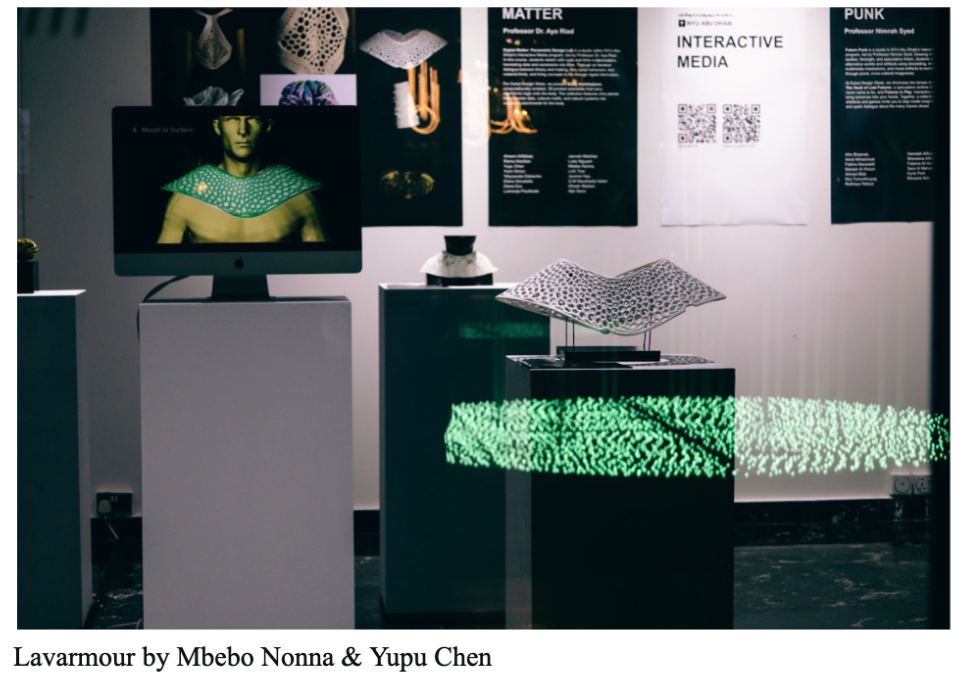
Lavarmour by Mbebo Nonna and Yupu Chen
Lavarmour draws from the elemental language of volcanic formations and the ancient engineering of chainmail to sculpt a 3D-printed wearable for the upper torso. Inspired by the fracturing crust of cooling lava and the interlaced resilience of medieval armor, the design captures both fluidity and fortification.
Neuraxis by Yumi Omori and Diana Donatella
Placing a representation of an internal organ on the outside of the body, this project reflects on embodiment and visibility. The brain – an emblem of consciousness and identity – is reinterpreted as a 3D-printed parametric headpiece, revealing its intricate folds to collective view. This inversion blurs the line between private and public, prompting reflection on how we define ourselves when the hidden becomes visible and the intimate becomes shared.
Verx.01 by Lukrecija Paulkalite and Ghadir Madani
This project explores the design of a spine protection wearable for female athletes. Combining a rigid PLA frame with a soft, impact-dispersing TPU mesh, the structure varies mesh density along high-risk areas of the spine to enhance impact absorption and stress distribution. Beyond its technical function, it seeks to foster confidence in female athletes through both safety and self-expression.
Zephyra by Javeria Haq and Naushadul Islam
Zephyra is a contemporary reinterpretation of the Renaissance collar, transforming a symbol of historical elegance into a futuristic statement piece. Inspired by the bold silhouette of the ruff, the design replaces heavy pleats with engineered mesh, maintaining its regal form while adding lightness and movement. Designed through parametric modeling and 3D printing, the piece balances structure and elegance, transforming a symbol of tradition into one of modern expression.

Future Punk:
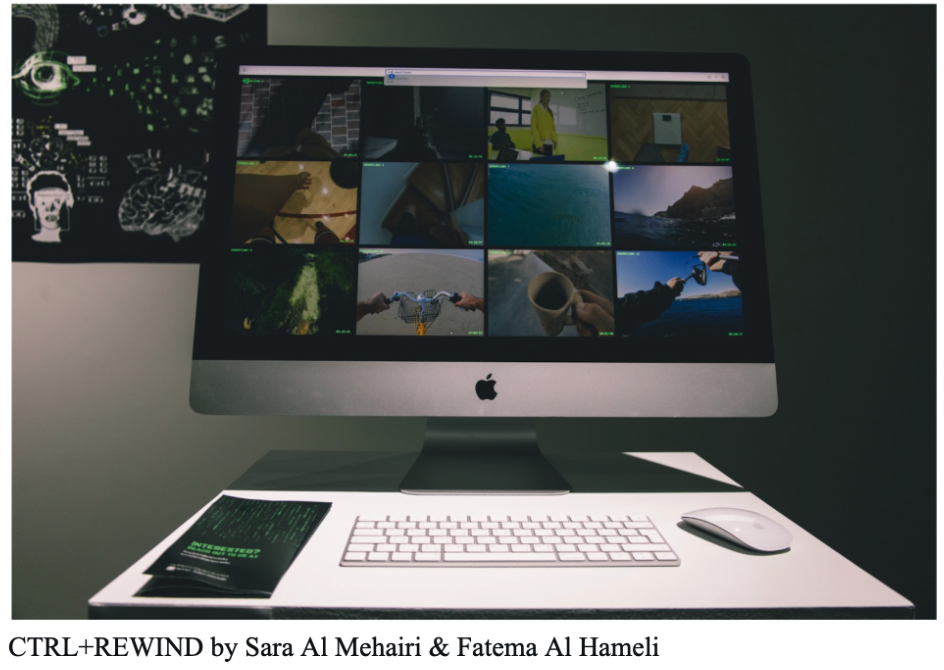
CTRL+REWIND by Sara Al Mehairi and Fatema Al Hameli
The work examines the lost future of MemoryLens, a speculative artifact designed for The Vault of Lost Futures, a future wearable technology that grants users the ability to record, replay, and re-experience every aspect of their lives. Through this project, we critically analyze what could have been with this future, such as the dangers of surveillance, the commercialization of personal data, and the disappearance of forgetting.
Extinction Countdown by Amal Almazrouei, Afra Binjerais, and Fatima Alsuwaidi
Extinction Countdown is a fast-paced, strategic card game where players step into the role of conservationists battling to protect endangered species from extinction. Combining competitive mechanics with educational storytelling, the game challenges players to defend their own species while confronting real-world threats, including habitat destruction, poaching, and climate change.
Hello? Is Anyone There? by Amal Almazrouei, Fatima Binjerais, Fatima Alsuwaidi
Set in the year 2075, the project takes the form of a speculative archive built around a now-lost device: the SpacePhone, developed by CosmoCom and widely used between 2050 and 2058 to speak directly with sentient extraterrestrials. Our project focuses on three conversations, recovered from that trove. Using a vintage-style interface, visitors can dial into different moments in time and eavesdrop on snippets of real human-alien dialogue.
When Worlds Collide by Sara Al Mehairi and Fatema Al Hameli
This is a competitive strategy card game where players create their own futuristic world while sabotaging others. Designed for 3–6 players, the game challenges participants to collect Build points through construction, manipulation, and disruption. Players draw from Build, Sabotage, Event, and Wild cards, each shaping the changing alliances and rivalries in play.
% $