

What a Particle Physics Lab Taught My Graphic Design Students
.jpg)
Designing across academic fields, institutions, time zones, and continents poses a challenge for any experienced designer. But what about for an undergraduate taking their very first design class? In Fall 2025, that is exactly the challenge a cohort of students in my Graphic Design elective at NYUAD took on as they developed a logo and visual identity for the FM Lab, a particle physics laboratory at the University of Sydney.
A research brief enters the studio
This project grew out of a connection between disciplines and institutions. Dr Laura Manenti, who previously worked as a researcher at NYU Abu Dhabi, invited our Graphic Design class to collaborate with her lab to develop a unique logo and identity. She and Dr Theresa Fruth lead FM Lab (short for Fruth and Manenti), a research group at Sydney that develops particle detectors and sensors. Its research includes dark matter searches, quantum sensing and other complex applications of particle detection.
Their brief to our class began with a manifesto: “In our lab, curiosity drives everything we do.” It described learning through experimentation and mistakes, and explicitly called the people in the lab its greatest asset. Laura even shared the story of Merlin and King Arthur to explain her perspective on mentorship; she wanted to recognize a student’s potential before the student could even see it themselves.
That gave us a direction far beyond a basic request for a "physics logo." Laura and Theresa wanted their students to feel proud to belong, to explore, and to grow. Other researchers, and eventually a wider public, would see this mark too. The identity needed to spark curiosity about the science while conveying collaboration, mentorship, and growth.
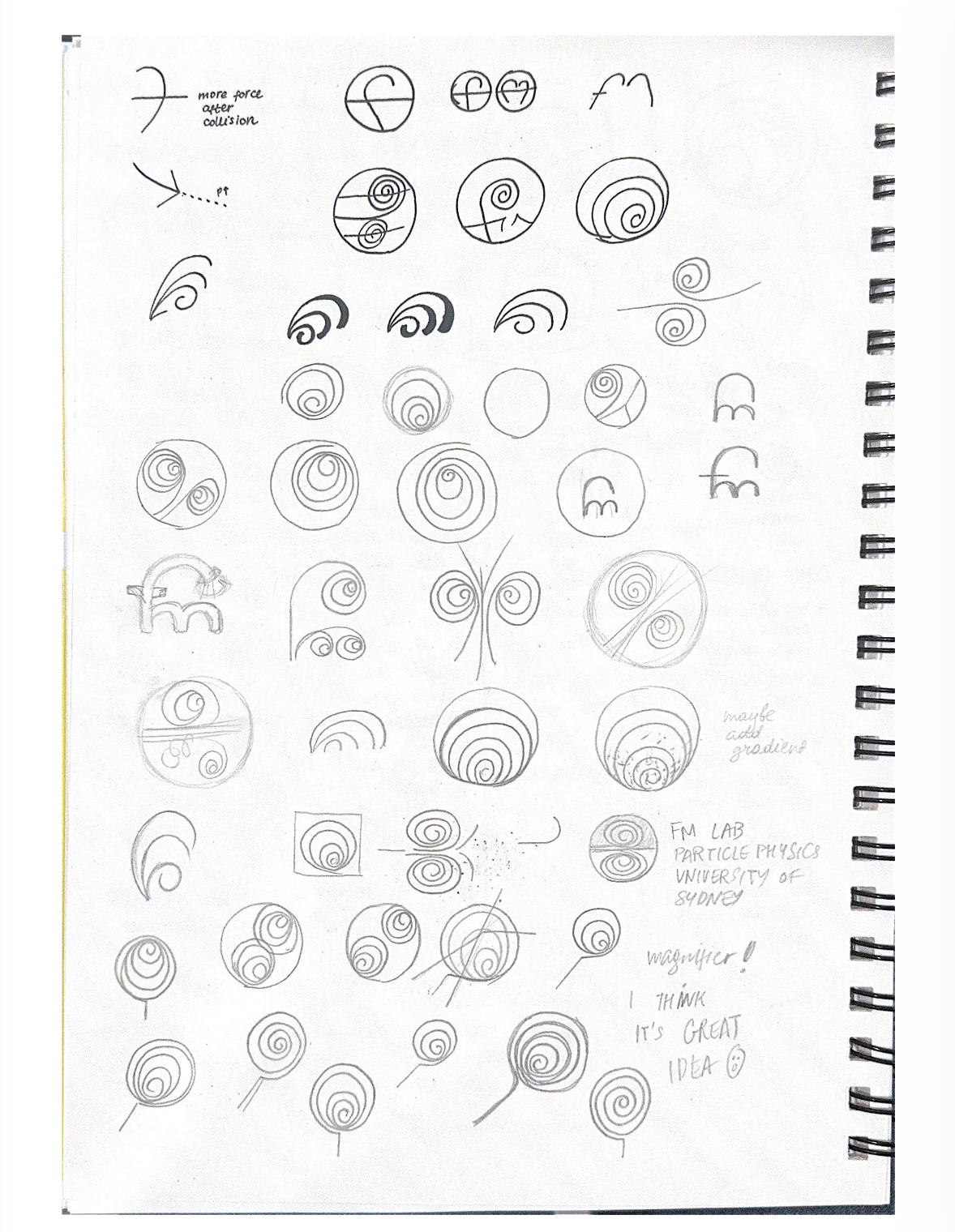
None of the Graphic Design students had a background in physics. Before designing, they first had to understand enough to ask useful questions: What does the lab actually study? What does it mean to build a detector and wait for an interaction? What would members want their identity to say about working together? We began with background research and interviews with the scientists, then moved through extensive sketching and early rounds of feedback. Learning the subject matter became linked to the design work itself.
Turning research into visual language
We divided the class into three small teams, each operating like a miniature design studio. The proposals explored different ways to connect the lab’s complex science with its supportive culture. One team worked with the visual language of intersecting particle tracks; another used a branching form to evoke growth; the direction eventually selected brought two spiraling paths into a shared circular mark.
Early ideas naturally leaned toward familiar cliches, like the classic Bohr model of the atom, which the researchers gently pointed out did not reflect their actual work. After this feedback, the teams returned to their research and developed visual metaphors genuinely grounded in the lab’s practice. They learned a crucial lesson: a logo can invite several meaningful interpretations while remaining accountable to what its subject actually does.
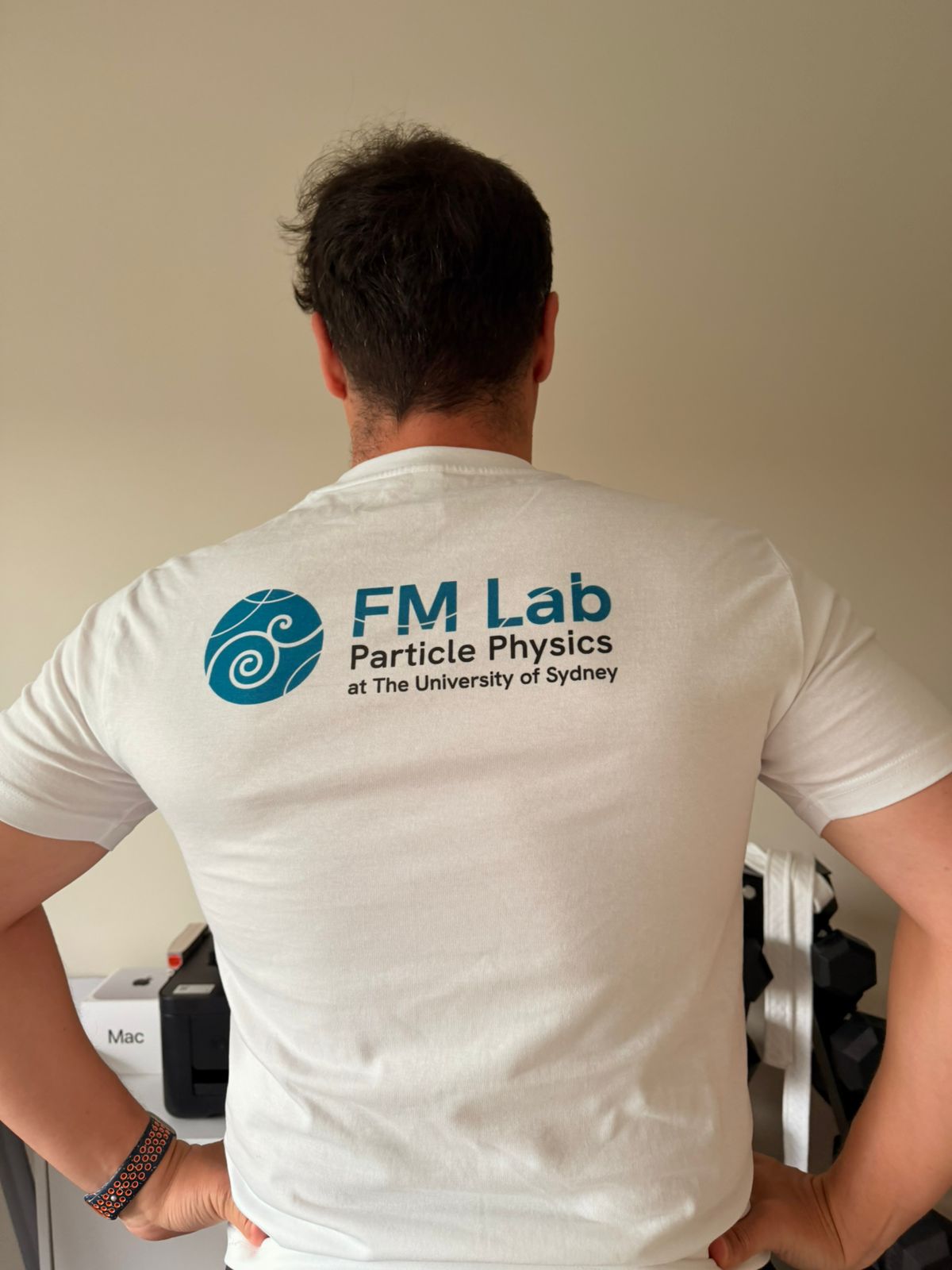
The live brief also brought practical demands. The lab had color preferences and envisioned the identity on everything from structural signage and embroidered shirts to presentation decks and research papers. Some applications would require naming the University of Sydney, demanding careful navigation of the institution's brand approval process. Within each team, students had to choose which ideas to carry forward and decide how to pivot when the client saw something differently. The reality that their work would actually be used gave their critiques clarity and pushed them to think beyond their own personal preferences toward what would really work.
From student proposals to a working identity
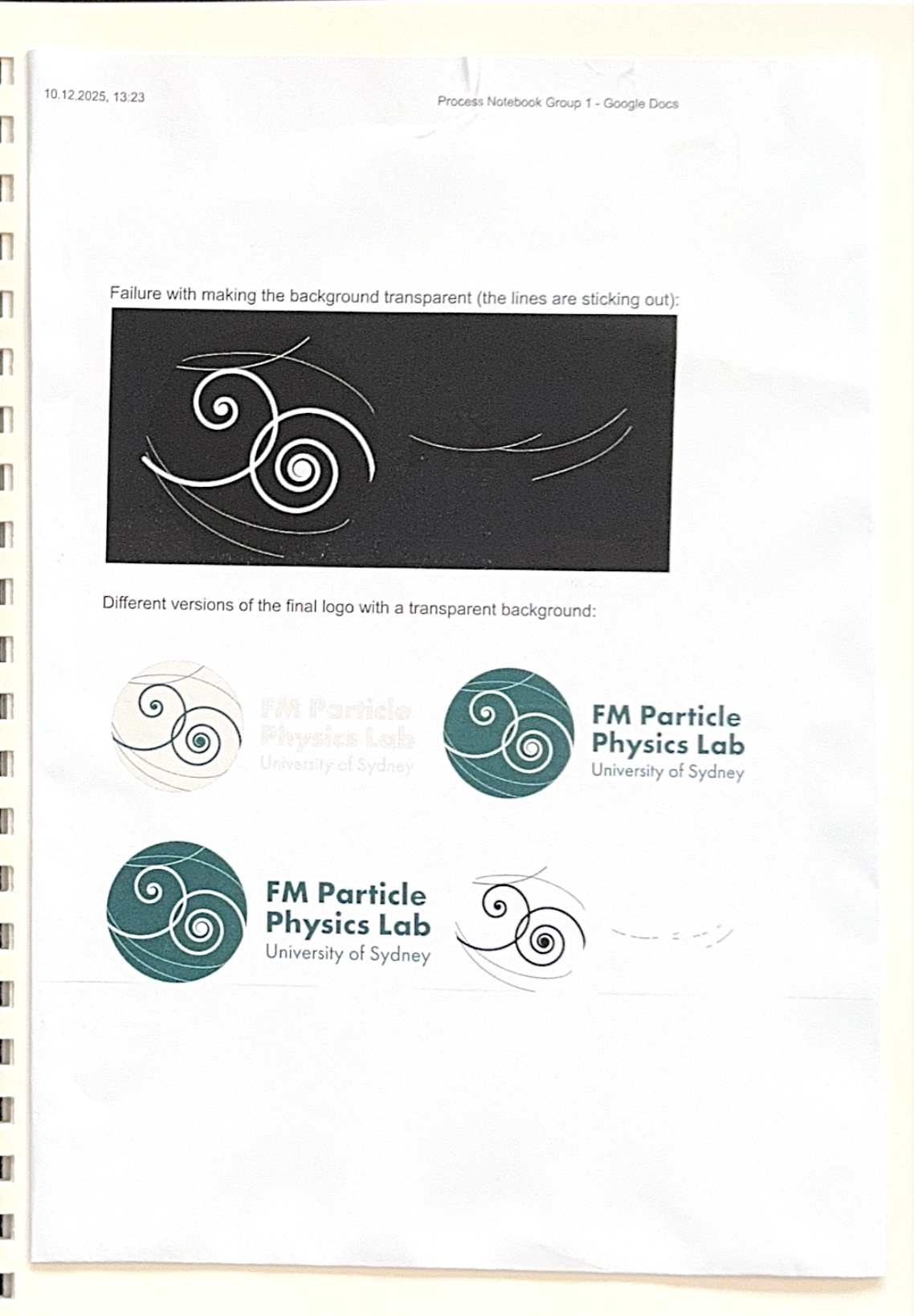
At the final presentation, the teams pitched their distinct concepts, and the FM Lab selected the interacting-trails proposal by Tiffany, Mariam, Raushan, and Adeliya. With Laura’s input, I refined their concept into the final teal logo, developing the enclosed circular mark and its typography for practical use. Two spirals meet within the circle, while lighter arcs suggest movement across its edges. The forms evoke intersecting particle trails while simultaneously representing the relationships among people whose work depends on one another.
Seeing the mark officially installed in the laboratory has made the assignment’s stakes tangible. A student team’s idea became part of how an active, international research group presents itself to the world. Their research and proposals had a real impact, as did the conversations and refinements that carried their initial direction into daily use. The finished identity signals an exploratory scientific pursuit while leaving room for the human qualities that give the FM Lab its distinctive ethos.
Designing for the real world
Design education at NYU Abu Dhabi has a long history of engaging students with real clients, live projects, and actual constraints. Through this process, students learn how to engage with complex, unfamiliar subject matter, operate with higher stakes and motivation, and eventually feel the pride of seeing their work deployed: displayed on walls, worn on t-shirts, and giving a visual voice to real organizations.
At NYUAD, we believe that even in an introductory course, students can contribute to a highly specialized field when they are equipped with a process for entering it: listen closely, research what you do not know, sketch widely, test interpretations, and revise together. The FM Lab’s manifesto treats mistakes as necessary for growth. Our students lived that principle as they moved beyond familiar imagery, negotiated difficult choices within their teams, and responded to a client whose highly technical work they were still learning to understand.
The logo on the FM Lab’s wall is the visible outcome of this process. But the experience of designing alongside others, solving real problems in real time, is what I hope stays with the students long after the semester ends.


